Running a workshop in English can feel like a big step (even if English is your first language, like it is for me!) You’re not just using the language, you’re explaining ideas, answering questions and giving feedback in real time.
In this post, I’d like to share my experience of delivering my first ever conference workshop – the IATEFL BESIG annual conference, in Athens, Greece. (You might be surprised that I get nervous too!)
Here’s how the workshop went…
Embracing visual thinking, especially sketchnoting, has transformed my teaching practice. So, I plucked up the courage to apply for the IATEFL BESIG First Time Speaker scholarship because I was keen to share my sketchnote techniques with others and give myself the challenge of speaking at a conference for the very first time.
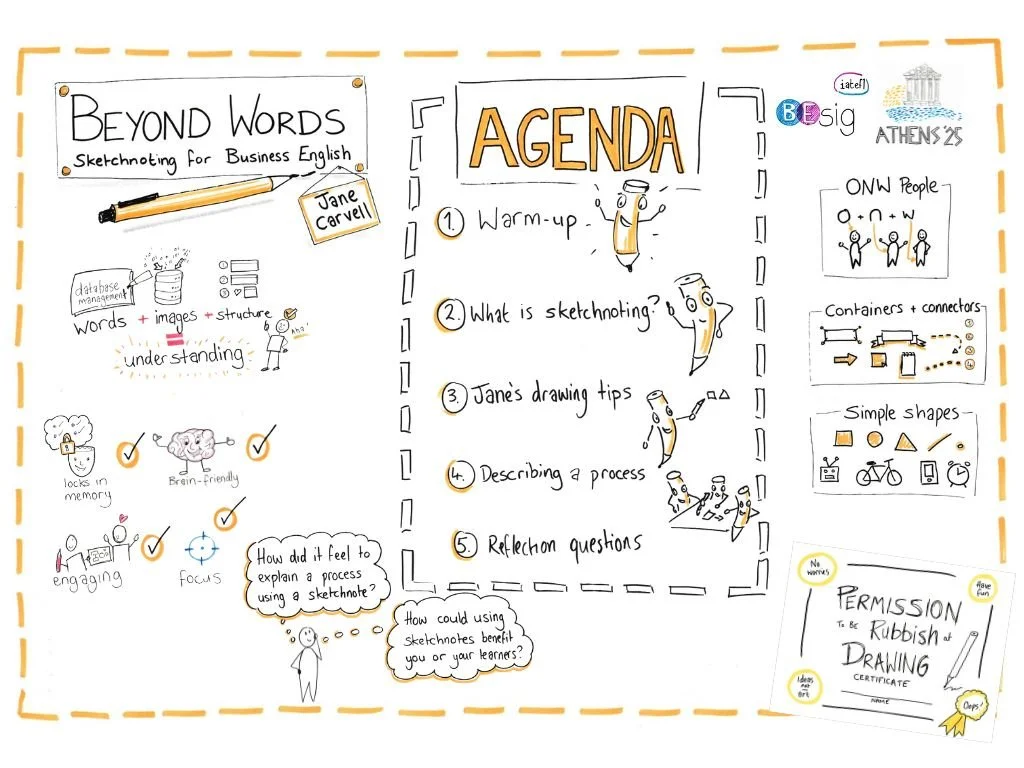
A simple way to use visual thinking in your workshops or meetings is to sketch the agenda.
Sketchnotes are a visual way of taking notes that combine hand-drawn elements (text, icons, arrows and shapes) to capture information in a memorable way. In a business English context, sketchnotes help ideas stick, spark engagement and create a path between language and understanding. By using visual thinking techniques, you can express yourself, connect more deeply, and find greater fulfilment at work. The business world is increasingly visual: dashboards, strategy canvasses, infographics and process maps are now commonplace in many workplaces. Developing visual literacy is an essential skill for workplace success, particularly when communicating across cultures.
I wanted to ground the workshop in credible theory. We touched briefly on Allan Paivio’s dual coding theory: the idea that combining words and images strengthens memory because information is processed through two channels instead of one. We also looked at how drawing supports focus and can help us get into a flow state (as described by Mihaly Csikszentmihalyi).
In simple terms: visuals help you understand and remember what you want to say.
But Jane…. “I can’t draw!” I hear you cry. Don’t worry, sketchnoting is about “Ideas not Art” (Mike Rohde, The Sketchnote Handbook, Pearson, 2013). In my sessions you are given permission to be absolutely rubbish at drawing. In fact, rough sketches often prove to be more effective as they make others feel more comfortable to collaborate and develop ideas when the image isn’t picture-perfect. For many people, this is a turning point. They realise that clear communication is more important than perfect drawings (or perfect English!).
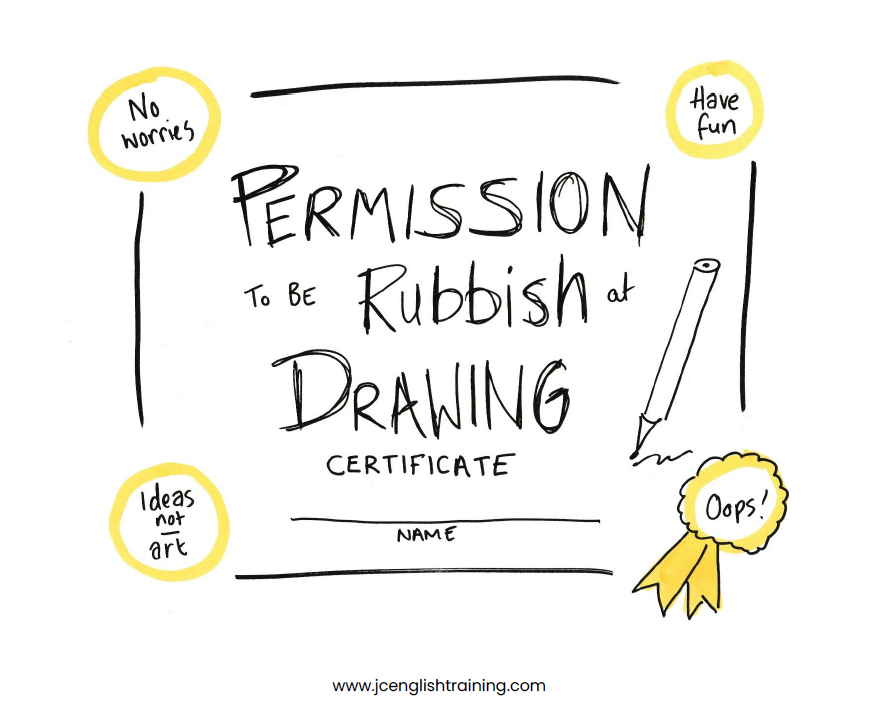
In the words of Mike Rohde, The Sketchnote Handbook, “Ideas, not art”.
In the workshop I shared a few examples of work produced by my clients from a wide range of professions, if accountants can draw – so can anyone!
Moving to the hands-on part of the workshop, I had already warmed up the participants with a short creative drawing activity. I then shared my tips for sketchnoting: focus on simple shapes, use connectors and containers, ‘ONW’ people (see sketchnote on opposite page), and draw boldly and quickly. The main task of the workshop was to explain a process using a sketchnote. The participants chose their own topics including ‘Planning a course’, ‘Making coffee’, ‘Getting to the conference’ and ‘Finding new students’. I’m pleased to report that the teams really delivered! I enjoyed seeing the processes being sketched out, with all the dynamic discussion happening it was clear to see how well the activity would work with language learners of all levels.
After the workshop, I felt energised by the positive feedback from the workshop attendees as well as feeling encouraged that my ‘thing’ for visual thinking is something of real value. If even a few participants left with the confidence to draw a frame, an icon or a stick figure, then for me the workshop was worthwhile.
For me, sketchnoting isn’t just doodling. It’s a visual thinking tool that transforms how we teach and learn communication.
Looking back, this experience gave me a lot of empathy and understanding for my clients. It’s a challenge to run an effective workshop but what matters more is having a clear concept and a way to communicate it.
Visual thinking is one way to support this. It helps you organise your thoughts, explain processes more clearly, and engage your audience.
In future posts, I’ll share more practical ideas to help you prepare for and run your own workshops in English.
I’d like to give a big thank you to IATEFL BESIG for giving me the gentle nudge to deliver my first conference workshop and offering me the First Time Speaker Scholarship as well as my friends at ELTA-Rhine for helping me prepare.
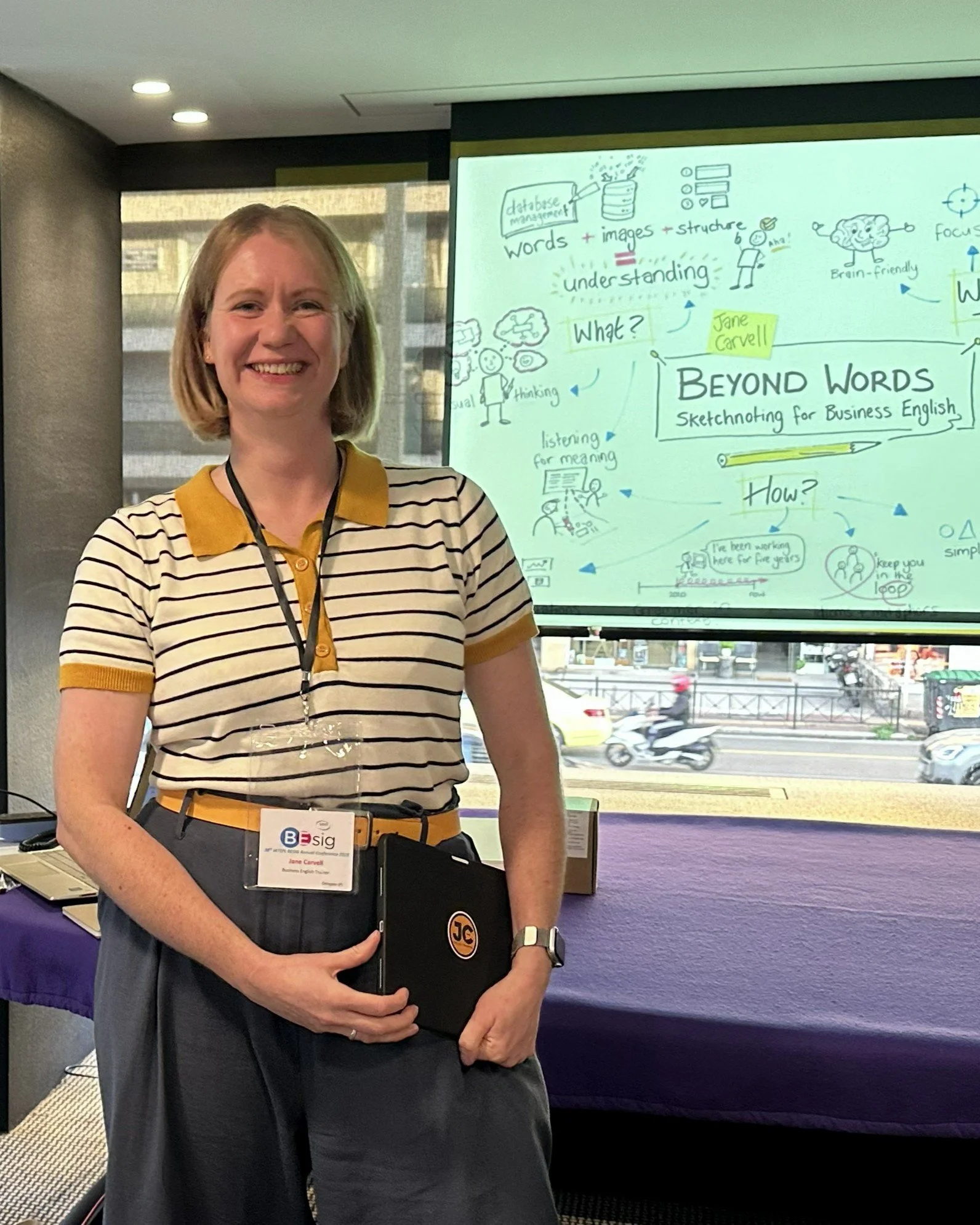
A happy workshop facilitator! Photo credit: Tanya Lesyk
Get in touch if you want to find out more about my visual thinking and sketchnoting workshop for you or your institution. ⬇️